My Network School Answer: The Age of Time Abundance
I was applying to Network School when I came across a question that stayed with me long after I closed the form:
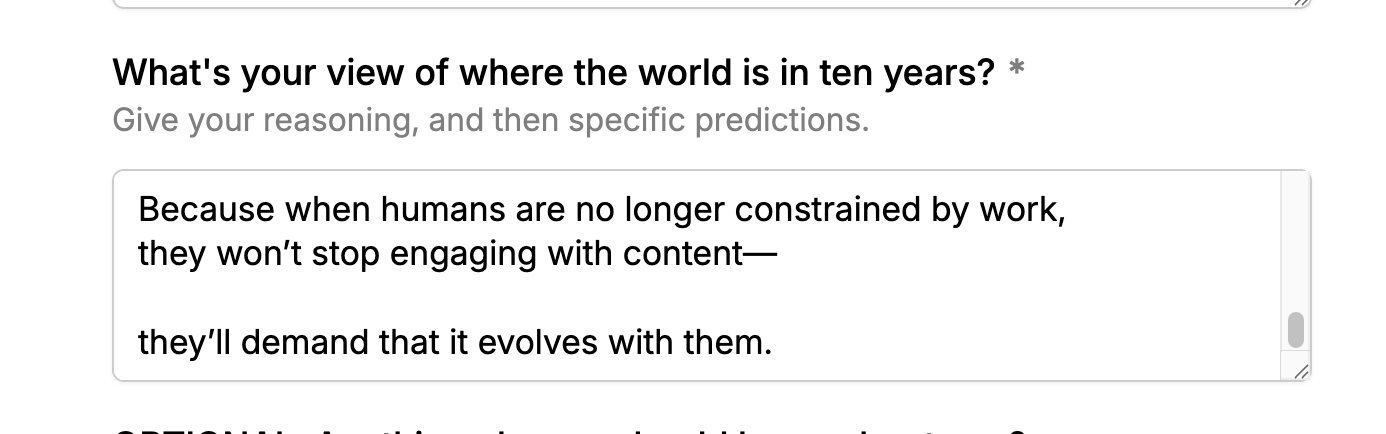
What’s your view of where the world is in ten years? Give your reasoning, and then specific predictions.
My answer started with a simple claim: in ten years, we won’t just be living in a world of intelligence abundance. We’ll be living in a world of time abundance.
As tokens get cheaper and AI systems absorb more cognitive and operational work, the shape of an ordinary day changes. Research, coordination, decision-making, and even creative production compress into near-zero-time interactions. What used to require teams gets handled by agents. What used to take days takes minutes.
The underappreciated second-order effect is this: humans get their time back.
And when humans get time back, they do three things. They create, they consume, and they reflect. That combination is combustible. It points toward content abundance at a scale we’ve never seen.
If intelligence is no longer the bottleneck, then creative expression isn’t either. Anyone can generate high-quality stories, videos, worlds, and experiences by spending tokens. The barrier to creation drops from capability to intent.
At the same time, consumption becomes hyper-personalized. Instead of selecting from a fixed catalog, people begin to expect content that adapts to mood, context, and taste in real time. We move from content scarcity to content abundance, from distribution bottlenecks to infinite supply, from mass media to personal media.
That shift changes the central problem. It is no longer, “How do we create content?” It becomes, “How do we navigate infinite content?”
In that world, every individual can generate a movie, anime, or story on demand. The average person consumes far more content per day. Media becomes ephemeral, dynamic, and deeply personalized. Traditional platforms, built around fixed libraries, start to look structurally misaligned. Taste and discovery become the highest-value layers in the stack.
This creates a paradox: when everything is available, nothing feels meaningful without the right interface.
That paradox is exactly why I’m building Instaflix.
Instaflix is designed for a world where content is not discovered, but generated. Instead of scrolling through a catalog, you prompt the story you want, the tone and pacing, the characters and world, even the emotional arc you are in the mood for. The system then generates bite-sized, anime-style experiences tailored to you.
In a token-abundant world, creation is infinite but attention is finite. Instaflix sits at that intersection: turning infinite creative possibility into something instantly consumable and emotionally meaningful.
Over the next decade, I think the most valuable consumer platforms will not be the ones that host content. They will be the ones that orchestrate intent into experience.
Netflix organized licensed content. YouTube democratized uploads. The next wave will let you generate exactly what you want to watch, exactly when you want it.
That is the shift I’m betting on.
Because when humans are no longer constrained by work, they won’t stop engaging with content. They’ll demand that it evolves with them.